

Script Already Written: Knicks Sweep Cavaliers, Leaving Cleveland With Hard Questions and a Long Offseason
A 37-point loss in Game 4 closed the book on Cleveland's season — and opened uncomfortable conversations about Harden, the roster and what this team is actually capable of.

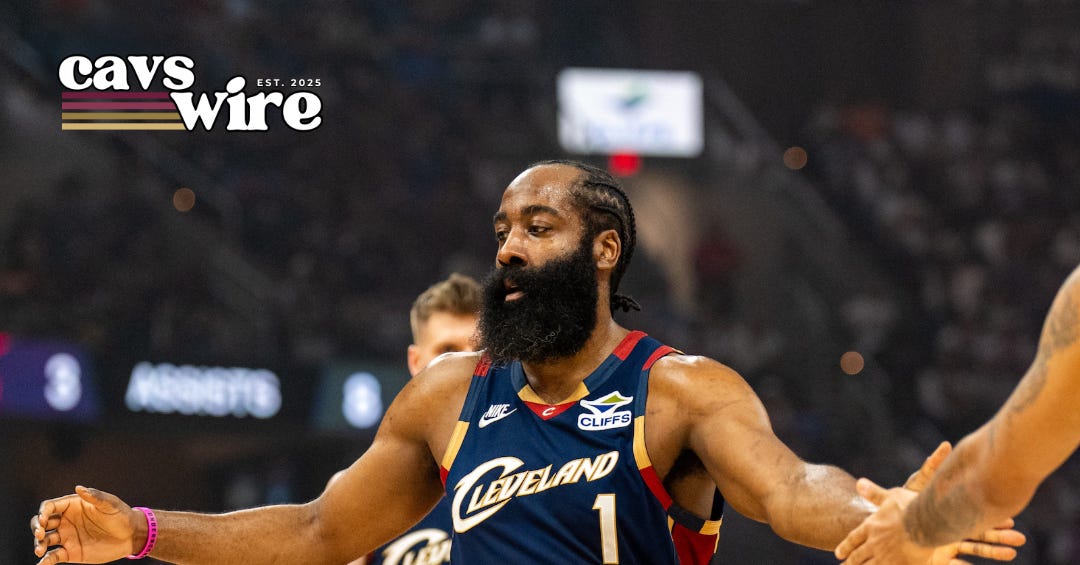
Swept out of the Eastern Conference Finals by the New York Knicks with a final score of 130-93, Game 4 felt less like a basketball game and more like the conclusion of a script that had already been written. For a team that had entered this season with an NBA Finals in mind, the sweep stings in a way the box score alone can’t capture. The final margin of the season — a whopping 37 points — only reinforced what became true across four games: this Cleveland team was not ready to compete at the level we believed they could.
Donovan Mitchell gave everything he had to try and rewrite that script. His 31 points on 9-for-18 shooting, including five of the Cavs’ 11 made threes, was the kind of performance that deserves another chance at taking a series. Kenny Atkinson didn’t mince any words on what Mitchell means to this team. “He’s the number one reason we went to the conference finals,” the coach said postgame. But those points, in yet another fantastic playoff performance, fell short — and raise yet another question: what exactly has he had to carry?
The 22 turnovers in Game 4 were the most visible issue that has shown up time and time again in this postseason run. Like many of the Cavaliers’ losses, the game wasn’t lost because New York was good — though they were, scoring 34 points off those turnovers, winning the paint battle 50-36 and outpacing Cleveland 32-5 in second-chance points. This game was lost because the Cavaliers couldn’t control the ball against pressure, couldn’t find a consistent half-court offense and were unable to find a second scorer next to Mitchell. James Harden put it plainly after the game. “We didn’t play not one quarter of just Cavs basketball offensively,” he said. “If you’re not making shots, you’re not going to beat anybody.”
Which of course brings the conversation to Harden.
The Harden experiment did not produce the results the front office was reaching for when they made the move to bring him to Northeast Ohio back in February. Across four games, Harden shot just 5-for-28 (17.9%) from deep on a team that needed his shooting more than anything. The Knicks knew this, and repeatedly challenged him to score in isolation. In Game 4, he finished the season with just 12 points on 2-for-8 shooting, going 0-for-6 from three in his 33 minutes. When prompted to assess his performance after the game, Harden had a measured response. “I don’t grade myself off shot making,” he said, pointing instead to his defense and playmaking. But his 3.3 assists per game and the ease with which the Knicks called into question his effectiveness — particularly by switching him onto Eastern Conference Finals MVP Jalen Brunson in Game 1 — made those contributions harder to quantify.
A secondary creator who can’t make defenses pay from three is a luxury a team trying to take down the surging Knicks simply cannot afford. His age — 36 — and only two and a half months to integrate into the system are factors worth considering. But whether those reasons are substantial enough to bring him back this summer is a question Koby Altman and the front office alone can answer.
Evan Mobley contributed seven rebounds and four assists in his 33 minutes, moving the ball well and continuing to show that playmaking is something the franchise can build on long-term. But his six points illustrated the offensive ceiling Cleveland continues to run into with him, and in a sweep, that limitation was shown in the spotlight. Jarrett Allen, whom I named this series’ X-factor in my preview, played just 25 minutes and finished with six points and three rebounds — underscoring that his fit alongside Mobley remains an awkward dynamic where both bigs needed to do more.
Atkinson pointed out in the postgame press conference that the road here wasn’t easy, mentioning two blown Game 6 leads in earlier rounds that could’ve been turning points. “I don’t want to say that’s the reason we lost,” he said, “but we would have had a better chance.” A team that never had more than a day of rest had come face-to-face with a Knicks squad that had swept its second-round matchup as well. With New York attacking the paint, Karl-Anthony Towns was relentless, posting 19 points and 14 rebounds and punishing Cleveland every time they turned it over. The Cavaliers’ longest run of the game was six points. New York’s was 20.
Even with that, Atkinson considered this season a success — carefully. “That was the task, right? Take another step,” he said. “Second round, second round, second round. Stuck on that. You make a jump.” He wasn’t exactly wrong. Getting to the conference finals was the floor for this squad even before the team was rebuilt in February, and it was an impressive feat for a group that had far less time to gel compared to the Knicks. But impressive and enough are very different things, and with Cleveland’s front office managing the league’s highest payroll as the only team in the second apron, hard decisions lie ahead on whether this group is truly built to win it all.
Donovan Mitchell deserves better than this. Whether Cleveland is the place that can give it to him is perhaps the most important question as the team starts a long offseason.